skip to main |
skip to sidebar
 Brian’s camera had to be returned, so we met at Stanhope and wandered off to see if we could find a cave in the Shittlehope Burn.
I’m not going to keep repeating the word “Shittlehope”. That sort of humour is just so schoolboy.
Brian’s camera had to be returned, so we met at Stanhope and wandered off to see if we could find a cave in the Shittlehope Burn.
I’m not going to keep repeating the word “Shittlehope”. That sort of humour is just so schoolboy.
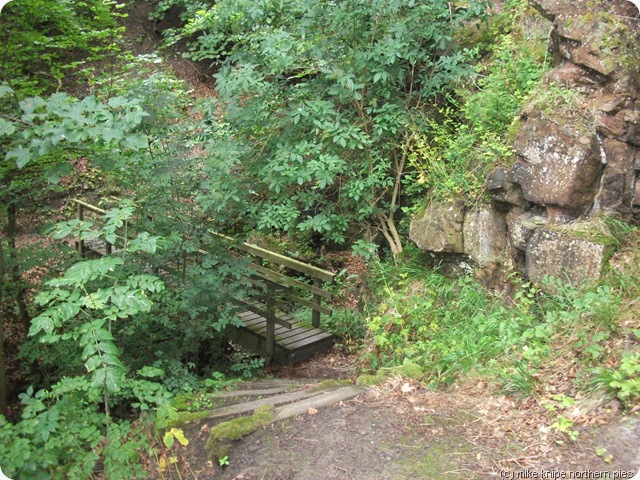
 Anyway, Shittlehope Burn (is nothing to do with eating curries…. damn….) - is found just to the left, or East of Stanhope. Its a little, wooded gill of exactly the kind of thing you find in the Pennines – full of ash trees and stuff. There’s a good, if muddy path.
I wasn’t quite sure whereabouts in Shittlehope (snigger..) the caves were, so, at the point where the path started to climb, we stuck to paddling up the beck.
That would be Shittlehope Beck, I shouldn’t wonder.
The cave is Lynnkirk Cave, in Shittlehope Burn. I guess that the limestone gorge is Lynn Kirk but the gill or dene is the other thing. (You know the word I mean. The S word….)
Anyway, Shittlehope Burn (is nothing to do with eating curries…. damn….) - is found just to the left, or East of Stanhope. Its a little, wooded gill of exactly the kind of thing you find in the Pennines – full of ash trees and stuff. There’s a good, if muddy path.
I wasn’t quite sure whereabouts in Shittlehope (snigger..) the caves were, so, at the point where the path started to climb, we stuck to paddling up the beck.
That would be Shittlehope Beck, I shouldn’t wonder.
The cave is Lynnkirk Cave, in Shittlehope Burn. I guess that the limestone gorge is Lynn Kirk but the gill or dene is the other thing. (You know the word I mean. The S word….)
 Then we came to an impasse. In a deep part of the gorge, where Shittlehope’s limestone walls started to close in, we came across a deep pool with a couple of tree trunks in it. It was too deep for the wellies. I estimated that I could wade through to the little waterfall at the other end with water at round about belly-button depth. An alternative was a chossy , mossy climb up a chimney which looked about Diff or V-Diff, but risky in wellies/without a rope.
So I re-arranged my dress-code, stored anything I wanted to keep dry and paddled in. It soon became clear that the water was much deeper than I’d guessed and the contents of the rucksack were likely to get very wet. So I abandoned.
Then we came to an impasse. In a deep part of the gorge, where Shittlehope’s limestone walls started to close in, we came across a deep pool with a couple of tree trunks in it. It was too deep for the wellies. I estimated that I could wade through to the little waterfall at the other end with water at round about belly-button depth. An alternative was a chossy , mossy climb up a chimney which looked about Diff or V-Diff, but risky in wellies/without a rope.
So I re-arranged my dress-code, stored anything I wanted to keep dry and paddled in. It soon became clear that the water was much deeper than I’d guessed and the contents of the rucksack were likely to get very wet. So I abandoned.


 We scrambled up a loose and earthy bank and found the path and easily bypassed the pool.
A short scramble down the very narrow gorge brought me to a large cave entrance with a substantial stream resurgence. I had a good old plodge and crawl around inside the passages.
We scrambled up a loose and earthy bank and found the path and easily bypassed the pool.
A short scramble down the very narrow gorge brought me to a large cave entrance with a substantial stream resurgence. I had a good old plodge and crawl around inside the passages.
 This was Lynnkirk cave. Its a Grade 1 (easy) about 360 feet long. Some parts were too low for a wanderer with no caving helmet on.

 Later, we had a short conversation with some bullocks (or were they stirks?) and repaired to the Bonny Moor Hen for a pint.
On the way – I met Peter Shepherd on a raid to the southern softlands. TGO Challengers are always popping up at unexpected moments. He gave me a bit of TGO gossip and news of another participant in our forthcoming Peebles to Moffat (and back) walk.
We walked about 2 miles altogether today – plus a bit of a paddle and a cave.
Happy birthday Brian. (There may be further pics of this and the Gaping Gill trip from Brian’s camera later)
Later, we had a short conversation with some bullocks (or were they stirks?) and repaired to the Bonny Moor Hen for a pint.
On the way – I met Peter Shepherd on a raid to the southern softlands. TGO Challengers are always popping up at unexpected moments. He gave me a bit of TGO gossip and news of another participant in our forthcoming Peebles to Moffat (and back) walk.
We walked about 2 miles altogether today – plus a bit of a paddle and a cave.
Happy birthday Brian. (There may be further pics of this and the Gaping Gill trip from Brian’s camera later)
 Not actually a weekend as it didn’t start till Sunday evening.
Late Sunday afternoon, I steered the knipemobile over Stainmore, down by Pendragon Castle, past the Wensleydale Cheese factory and to Clapham with a brief stop for pie and chips in Ingleton. (And very nice they were too – from the chipper there….)
After a few light bevvies in the New Inn (which is very old, as it happens) I was joined by Brian and Charlie, Colin from the Hare and Hounds and Ellis, a Weardale bobby. We had a bit of a session.
Later – much later, we put tents up exactly where we shouldn’t and drifted off to bye byes for a while. We determined to rise and shine at about 6:30 a.m. for the walk up to Gaping Gill.
Not actually a weekend as it didn’t start till Sunday evening.
Late Sunday afternoon, I steered the knipemobile over Stainmore, down by Pendragon Castle, past the Wensleydale Cheese factory and to Clapham with a brief stop for pie and chips in Ingleton. (And very nice they were too – from the chipper there….)
After a few light bevvies in the New Inn (which is very old, as it happens) I was joined by Brian and Charlie, Colin from the Hare and Hounds and Ellis, a Weardale bobby. We had a bit of a session.
Later – much later, we put tents up exactly where we shouldn’t and drifted off to bye byes for a while. We determined to rise and shine at about 6:30 a.m. for the walk up to Gaping Gill.
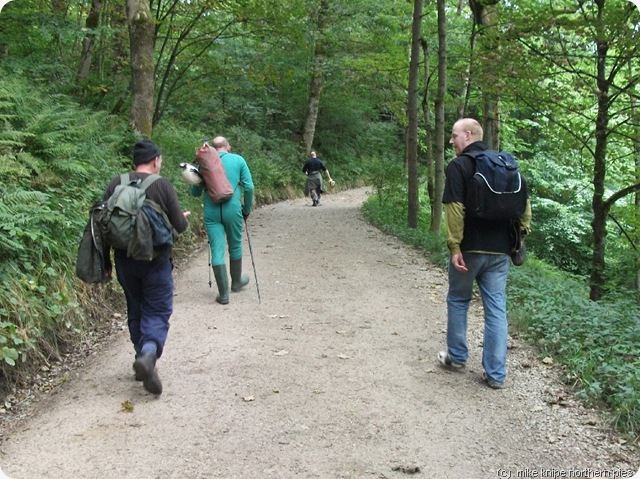 At 7:00 a.m. we heard the distinct raised voice of the local National park toilet attendant berating a family in a camper van and offering to fine them £50. He wasn’t personally all that bothered, but the camping ban was to stop things like this (I guess he was indicating our tents at this point) and said that this (indicating the tents) was ridiculous.
Brian soothed him using a bit of diplomacy but the toilet man said he was going to report us “to Bradford”. I think he meant Bradford Pothole Club who, if he did mention it to them, were not likely to be very interested.
At 7:00 a.m. we heard the distinct raised voice of the local National park toilet attendant berating a family in a camper van and offering to fine them £50. He wasn’t personally all that bothered, but the camping ban was to stop things like this (I guess he was indicating our tents at this point) and said that this (indicating the tents) was ridiculous.
Brian soothed him using a bit of diplomacy but the toilet man said he was going to report us “to Bradford”. I think he meant Bradford Pothole Club who, if he did mention it to them, were not likely to be very interested.
 It was an ill wind, though (it got us up) and we were soon embarked on the short walk up to Gaping Gill.
At this time of year, Craven Pothole Club organise a winch meet at Gaping Gill, which allows easy access down the 350 foot shaft into the Gaping Gill cave system. Its a spectacular ride both down and up and the only down side to it are the queues that can build-up at the bottom and the top.
It was an ill wind, though (it got us up) and we were soon embarked on the short walk up to Gaping Gill.
At this time of year, Craven Pothole Club organise a winch meet at Gaping Gill, which allows easy access down the 350 foot shaft into the Gaping Gill cave system. Its a spectacular ride both down and up and the only down side to it are the queues that can build-up at the bottom and the top.
 But today was relatively quiet and we were soon individually hurtling down through semi-darkness and a slight waterfall to arrive smoothly on the cobbles and stones at the bottom of this mighty hole.

 We gathered and set off toward Sand Cavern, though most of the party dropped out and made their way back. Me and Brian crawled around for a while and gave ourselves about half an hour as Ellis had to be back in Durham for his shift by tea time, and there was the potential for a long wait in the queue to get back out.
 So, we didn’t get much of an explore. I think we were underground for a couple of hours or so, but there was no wait and we were soon sploshing through the rain back to Clapham.
 The three peeps we’d lost had left for Co Durham, so it was just me and Brian who later sat in Bernie’s cafe in Ingleton with pots of tea and a bowl of chips.
The walk above ground was about 5 miles. The underground but was much, much less.
And it was Brian’s birthday and 50 years since his first trip down Gaping Gill.
There may be more pics from Brian later (But he’s left his camera in my car) I await a response from Bradford Pothole Club. Our excuse is, I’m afraid, that we were, in fact, very very drunk.
The three peeps we’d lost had left for Co Durham, so it was just me and Brian who later sat in Bernie’s cafe in Ingleton with pots of tea and a bowl of chips.
The walk above ground was about 5 miles. The underground but was much, much less.
And it was Brian’s birthday and 50 years since his first trip down Gaping Gill.
There may be more pics from Brian later (But he’s left his camera in my car) I await a response from Bradford Pothole Club. Our excuse is, I’m afraid, that we were, in fact, very very drunk.
 Now that its been a few days since I finished the walk along the Border, I thought I would put down some thoughts which may be useful for anybody else who is considering this
 madness undertaking.
There is no set route. It’s not an official Long Distance Walk (although it has a lot of potential). But there is, of course, the Border itself. This is a definite line which runs from the Solway Firth, along the River Sark, East-West on an earth bank called the Scots Dyke, along the River Liddel and the Kershope Burn, through the Cheviot Hills then through the arable countryside of North Northumberland and the Borders, and , along the River Tweed, finally turning North a few kilometres east of Berwick to the sea.
As there’s no set route, people are free to do whatever they desire. I think its best that this remains the case.
Day 1 Carlisle to Longtown
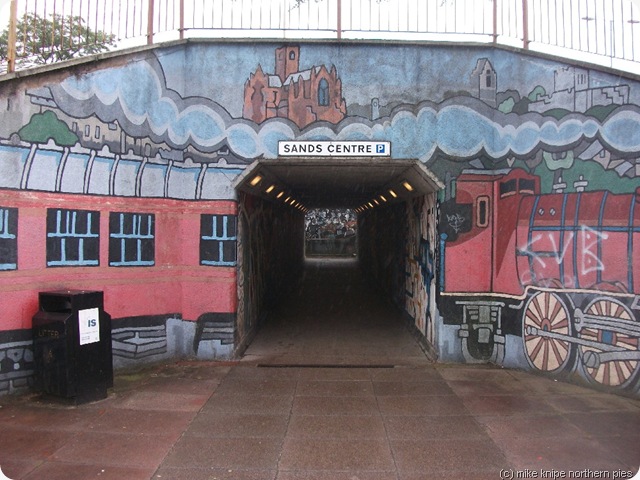 I started at Carlisle. The nearest town to the start of the West-East border is Gretna. Starting here would provide the advantage of an opportunity for a quick marriage before setting off. Other than that, it seems that there would be much road walking to start with. This may not be entirely true. (See Day 2) I would need to explore this further.
But why did I start at Carlisle?
1) Its very easy to get to from Chez Knipe. It has a railway station strategically placed on the West Coast main line.
2) the Cumbria coastal path leads easily alongside the River Eden to the Solway, where the Border is.
The path by the Eden is well signposted and waymarked and the stiles and footbridges are all in good order. I probably left the riverside path a bit early but the eastward route from Rockcliffe was on quiet lanes and I soon joined a path on the a bit of disused railway line, which was very nice. More roadwalking followed to Arthuret and more field paths to Longtown.
Longtown has pubs, shops, cafes and beds and there are campsites on either side of the Border within a couple of miles. Its a good place to stop.
I was happy with my route for day 1
Day 2 Longtown to Newcastleton
I started at Carlisle. The nearest town to the start of the West-East border is Gretna. Starting here would provide the advantage of an opportunity for a quick marriage before setting off. Other than that, it seems that there would be much road walking to start with. This may not be entirely true. (See Day 2) I would need to explore this further.
But why did I start at Carlisle?
1) Its very easy to get to from Chez Knipe. It has a railway station strategically placed on the West Coast main line.
2) the Cumbria coastal path leads easily alongside the River Eden to the Solway, where the Border is.
The path by the Eden is well signposted and waymarked and the stiles and footbridges are all in good order. I probably left the riverside path a bit early but the eastward route from Rockcliffe was on quiet lanes and I soon joined a path on the a bit of disused railway line, which was very nice. More roadwalking followed to Arthuret and more field paths to Longtown.
Longtown has pubs, shops, cafes and beds and there are campsites on either side of the Border within a couple of miles. Its a good place to stop.
I was happy with my route for day 1
Day 2 Longtown to Newcastleton
 I messed up the navigation at the start of this. It seemed like a good idea at the time, but lead to a cul-de-sac as far as off-road walking was concerned. A lot of road walking followed, with bits of bridleway on the English side.
I noted, at the Border crossing near Canonbie that the Scots Dyke has a footpath sign pointing to it. If there’s a pathg along the Scots Dyke, this would be very useful for a Gretna start.
But, from Longtown, the English side of the Border may offer footpaths for use, although most of these go North-South which is less than useful for an West-East route.
The Waverley line – to old railway route from Carlisle to Edinburgh is not open for walking on , at least the parts I saw weren’t feasible. This is a pity. It goes to Newcastleton….
The English side also offers the alternative of following the Border more closely along Kershope Burn. this is all forest roads and would miss Newcastleton and heads directly for Kielder. This might take an extra day for mortals like wot I am.
Newcastleton has beds, pubs, hotels and expensive but friendly camping. It may be possible to camp for free alongside the riverside which is short green grass and a local walk.
Day 3 Newcastleton to Kielder
I messed up the navigation at the start of this. It seemed like a good idea at the time, but lead to a cul-de-sac as far as off-road walking was concerned. A lot of road walking followed, with bits of bridleway on the English side.
I noted, at the Border crossing near Canonbie that the Scots Dyke has a footpath sign pointing to it. If there’s a pathg along the Scots Dyke, this would be very useful for a Gretna start.
But, from Longtown, the English side of the Border may offer footpaths for use, although most of these go North-South which is less than useful for an West-East route.
The Waverley line – to old railway route from Carlisle to Edinburgh is not open for walking on , at least the parts I saw weren’t feasible. This is a pity. It goes to Newcastleton….
The English side also offers the alternative of following the Border more closely along Kershope Burn. this is all forest roads and would miss Newcastleton and heads directly for Kielder. This might take an extra day for mortals like wot I am.
Newcastleton has beds, pubs, hotels and expensive but friendly camping. It may be possible to camp for free alongside the riverside which is short green grass and a local walk.
Day 3 Newcastleton to Kielder
 This was almost all forest. There’s nothing much to be done about this if you want to go to Kielder, although there are several options through the forest. Forestry Commission signage is aimed at cyclists who know the place already, it would seem. I found the signage confusing. the Border route appears to be only signposted in one direction and is often counter-intuitive.
Despite the map, there is no path over Larriston Fell. If you go this way, you are warned, strongly, that it is very very rough going indeed. It seems to me that any clear hilltops surrounded by commercial forest are a sea of tussock, lank heather and bog. I suspect its because there are no sheep to trim the herbage. There’s a new mountain bike track which goes to Kielder from Bloodybush. This squiggles about a bit, but its much easier than Larriston.
Day 4 Kielder to Byrness
This was almost all forest. There’s nothing much to be done about this if you want to go to Kielder, although there are several options through the forest. Forestry Commission signage is aimed at cyclists who know the place already, it would seem. I found the signage confusing. the Border route appears to be only signposted in one direction and is often counter-intuitive.
Despite the map, there is no path over Larriston Fell. If you go this way, you are warned, strongly, that it is very very rough going indeed. It seems to me that any clear hilltops surrounded by commercial forest are a sea of tussock, lank heather and bog. I suspect its because there are no sheep to trim the herbage. There’s a new mountain bike track which goes to Kielder from Bloodybush. This squiggles about a bit, but its much easier than Larriston.
Day 4 Kielder to Byrness
 There seems to be three options:
1) I followed the bridleway from East Kielder to Catcleugh. This was an absolute nightmare. Its almost as rough as Larriston, but goes on much, much further. Some of the bridleway is impassable. It is, however, the shortest route to Byrness, if thats where you want to go.
2) The toll road to the A68 near Byrness followed by a quick hop up the Pennine Way. Probably the easiest. Its almost all hard surface forestry road, though.
3) The border ridge to Carter Bar and beyond.
This is rough stuff. It is the purest route, sticking close to the Border. It visits the Kielder Stone which was a meeting point of the Marcher authorities for the dispensation of local justice, so its a significant point.
It also visits the tea van on the Border at Carter bar.
You can drop down to Byrness either before or after Carter Bar.
Its a fine route, but its a very long way to Byrness and an extra half day might well be needed.
It would be possible, of course, just to continue along the Border and bypass Byrness altogether. Tough guys would do this.
Day 5 PW from Byrness
There seems to be three options:
1) I followed the bridleway from East Kielder to Catcleugh. This was an absolute nightmare. Its almost as rough as Larriston, but goes on much, much further. Some of the bridleway is impassable. It is, however, the shortest route to Byrness, if thats where you want to go.
2) The toll road to the A68 near Byrness followed by a quick hop up the Pennine Way. Probably the easiest. Its almost all hard surface forestry road, though.
3) The border ridge to Carter Bar and beyond.
This is rough stuff. It is the purest route, sticking close to the Border. It visits the Kielder Stone which was a meeting point of the Marcher authorities for the dispensation of local justice, so its a significant point.
It also visits the tea van on the Border at Carter bar.
You can drop down to Byrness either before or after Carter Bar.
Its a fine route, but its a very long way to Byrness and an extra half day might well be needed.
It would be possible, of course, just to continue along the Border and bypass Byrness altogether. Tough guys would do this.
Day 5 PW from Byrness
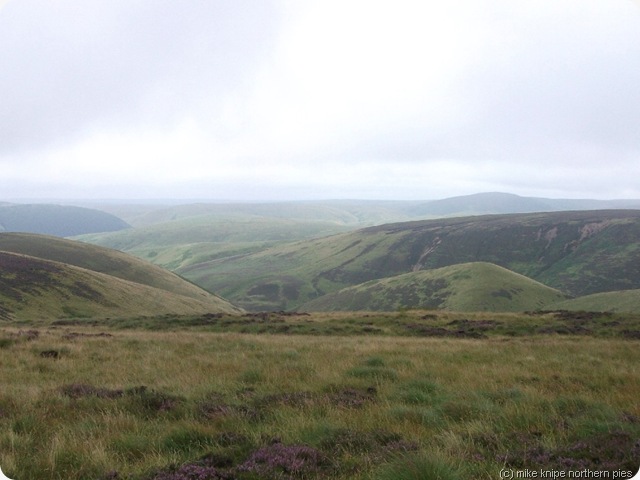 Follows the Pennine Way. Much easier walking from Byrness onwards. Forest view have a van/bus which will pick you up from Trow for a small consideration, thus avoiding the need to wild camp. There’s also accomodation well off route at Barrowburn.
An alternative would be to drop down along one of the cross-border roads – Dere Street goes close to Jedburgh and The Street does similar stuff. This might be more useful for finding a camping spot or for very bad weather.
Day 6 Beaumont valley to Town Yetholm
Follows the Pennine Way. Much easier walking from Byrness onwards. Forest view have a van/bus which will pick you up from Trow for a small consideration, thus avoiding the need to wild camp. There’s also accomodation well off route at Barrowburn.
An alternative would be to drop down along one of the cross-border roads – Dere Street goes close to Jedburgh and The Street does similar stuff. This might be more useful for finding a camping spot or for very bad weather.
Day 6 Beaumont valley to Town Yetholm
 Should have continued following the Pennine Way, but I dropped down the Beaumont valley to Town Yetholm.
Its also possible to drop down into the Colledge valley.
Town Yetholm has beds, a campsite, a hotel and a good shop. Kirk Yetholm has it’s hotel. Informal camping is possible beside the river in between the two.
Day 7 Town Yetholm to Twizel
Should have continued following the Pennine Way, but I dropped down the Beaumont valley to Town Yetholm.
Its also possible to drop down into the Colledge valley.
Town Yetholm has beds, a campsite, a hotel and a good shop. Kirk Yetholm has it’s hotel. Informal camping is possible beside the river in between the two.
Day 7 Town Yetholm to Twizel
 The path from Town Yetholm to Hoselaw is open and easy to follow. After that there are few paths on the Scottish side of the Border and, after some initial stretches of walking on very quiet lanes, there are mainly good paths on the English side, with a few notable exceptions where there are some serious issues about blockages.
Cornhill on Tweed has a small shop and an hotel, but Coldstream is much bigger and has a supermarket, many hotels, pubs, B&Bs and girls in tight shorts……
The signed path to Norham/Berwick (10 and 20 miles respectively) appears not to be a continuous path, the railway bridge over the River Till being dubious as a crossing at the moment. CI’ve asked Northumbria CC about this)
Late edit: I just discovered that you can cross the disused railway bridge over the River Till by a permissive path. This misses out the junction of the Tweed and the Till and a bit of riverside path but avaoids a couple of miles of road walking beside a busy A road. So it's better, see?
Day 8 Along the Tweed to Berwick
The path from Town Yetholm to Hoselaw is open and easy to follow. After that there are few paths on the Scottish side of the Border and, after some initial stretches of walking on very quiet lanes, there are mainly good paths on the English side, with a few notable exceptions where there are some serious issues about blockages.
Cornhill on Tweed has a small shop and an hotel, but Coldstream is much bigger and has a supermarket, many hotels, pubs, B&Bs and girls in tight shorts……
The signed path to Norham/Berwick (10 and 20 miles respectively) appears not to be a continuous path, the railway bridge over the River Till being dubious as a crossing at the moment. CI’ve asked Northumbria CC about this)
Late edit: I just discovered that you can cross the disused railway bridge over the River Till by a permissive path. This misses out the junction of the Tweed and the Till and a bit of riverside path but avaoids a couple of miles of road walking beside a busy A road. So it's better, see?
Day 8 Along the Tweed to Berwick
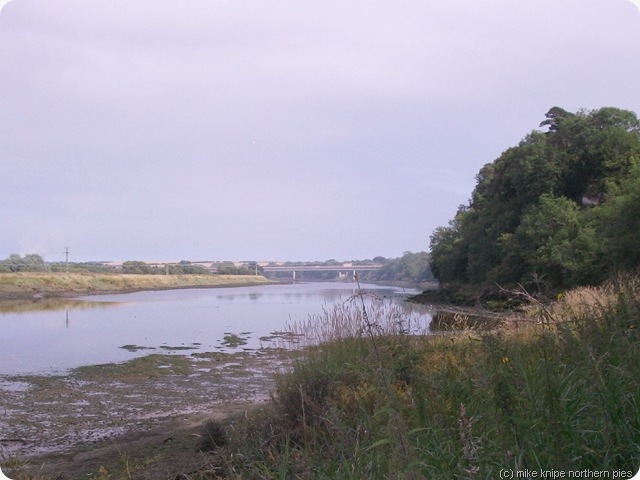 Riverside paths by the Tweed are generally fairly good and give a fine route into Berwick. The Scottish side of the river appears not to have a continuous route. I don;t think there’s a sensible alternative to this.
There are shops, pubs and beds at Norham and Horncliffe and a campsite off route a bit South of Horncliffe.
The locals are specially friendly.
And that’s it. I guess that, depending on the route, you’d be looking at 7 to 10 days for this jaunt. There are no rules, remember (that’s a rule I just made) but you have to stay as close to the Border as your concience demands.
If,of course, you happened to be walking around the coast/perimeter of England (?and Wales) – you really ought to stay on the English side of the line, eh?
I’m off to do something different now….
Riverside paths by the Tweed are generally fairly good and give a fine route into Berwick. The Scottish side of the river appears not to have a continuous route. I don;t think there’s a sensible alternative to this.
There are shops, pubs and beds at Norham and Horncliffe and a campsite off route a bit South of Horncliffe.
The locals are specially friendly.
And that’s it. I guess that, depending on the route, you’d be looking at 7 to 10 days for this jaunt. There are no rules, remember (that’s a rule I just made) but you have to stay as close to the Border as your concience demands.
If,of course, you happened to be walking around the coast/perimeter of England (?and Wales) – you really ought to stay on the English side of the line, eh?
I’m off to do something different now….
 Quite a nice end to the walk.
I set off from the Twizel camp and wandered down the easiest of footpaths towards the sea. The river had herons, swans, ducks and fishermen, mostly up to their naughty parts in Tweed (thats the river, not the trousers).
Quite a nice end to the walk.
I set off from the Twizel camp and wandered down the easiest of footpaths towards the sea. The river had herons, swans, ducks and fishermen, mostly up to their naughty parts in Tweed (thats the river, not the trousers).

 I coasted towards Norham where I had a brief conversation with a bloke and his little black dog. He told me that the path at Horncliffe was closed due to some work going on there. I failed to ask him what the work was about. I was suspicious of another Northumberland CC footpath fiasco. I went to Norham’s village shop and bought a pork and apple butty, some orange juice, an orange and some choccy bars. Robert the Bruce had been here previously, apparently and had not yet paid for his fags.
 After Norham the path is narrow and runs alongside an unstable sandstone crag. There are no difficulties, though, and soon signs started appearing telling me that the path was closed at Horncliffe Burn. And it was.
But not to worry, another footpath headed South through the woods adn across a cornfield to Norham east Mains farm and thence to a minor road which could be used to outflank whatever it was they were doing in Horncliffe Burn.
After Norham the path is narrow and runs alongside an unstable sandstone crag. There are no difficulties, though, and soon signs started appearing telling me that the path was closed at Horncliffe Burn. And it was.
But not to worry, another footpath headed South through the woods adn across a cornfield to Norham east Mains farm and thence to a minor road which could be used to outflank whatever it was they were doing in Horncliffe Burn.

 The woodland grew ever thicker as I hacked my way South and son,yes, you’ve guessed it, no further progress was possible. There was thick vegetation including hawthorn, fence wire and monster nettles. I struggled out of the cul-de-sac and determined to go around. The subsequent obstacle course included a large embankment of the very same kind that they used to build motte and bailey castles on, and complete with even bigger and stingier stinging nettles. I found the stile into the woods at the far end of the jungle. It was derelict and surrounded by deep, lush green stuff. Yes folks, my third Northumberland County Council Comedy Footpath. Does nobody walk around here? Does the Council have a rights of way department and are they overworked, underfunded, underpaid and has their dog died recently?
The demesne farm was, apparently deserted and I finally made it to the road.
Which was closed!
They were resurfacing it. But the natives were friendly and I had a short chat with the man on the road roller. He offerred me a lift on it, in fact and told me that I could wark doon thah middel of thah rooooad as it were cloooazd fer sarfassin.
The woodland grew ever thicker as I hacked my way South and son,yes, you’ve guessed it, no further progress was possible. There was thick vegetation including hawthorn, fence wire and monster nettles. I struggled out of the cul-de-sac and determined to go around. The subsequent obstacle course included a large embankment of the very same kind that they used to build motte and bailey castles on, and complete with even bigger and stingier stinging nettles. I found the stile into the woods at the far end of the jungle. It was derelict and surrounded by deep, lush green stuff. Yes folks, my third Northumberland County Council Comedy Footpath. Does nobody walk around here? Does the Council have a rights of way department and are they overworked, underfunded, underpaid and has their dog died recently?
The demesne farm was, apparently deserted and I finally made it to the road.
Which was closed!
They were resurfacing it. But the natives were friendly and I had a short chat with the man on the road roller. He offerred me a lift on it, in fact and told me that I could wark doon thah middel of thah rooooad as it were cloooazd fer sarfassin.
 Eventually, I arrived in Horncliffe where I took up a short residence of the public bar in the Fishers Inn. The nice lass behind the bar told me that a) she knew the bloke at Norham and his little black dog and b) the path to Berwick was closed due to a landslip.
 I progressed towards BOT. There was no landslip. The path was nice and easy with just the two or three contours near the end. I passed by the Union Bridge where, I noticed as I chomped the pork and apple butty, that most drivers arrive and turned around again due to the narrow bollards. I wandered briefly into Scotland before continuing along the riverbank.
 Soon after this, the river began to smell of seaweed. I had reached the tidal part. And, ahead, I could now see a large, modern road bridge. this carried the A1 road to Edinburgh. It was busy and difficult to cross.
A bit further on a man in a boiler suit who seemed to be setting fire to piles of “stuff” pointed out the path to Berwick and gave me accurate directions to the nearest and finest fish and chip shop – I thought he said “Fowlers”, but actually he said “Foulis”.
Soon after this, the river began to smell of seaweed. I had reached the tidal part. And, ahead, I could now see a large, modern road bridge. this carried the A1 road to Edinburgh. It was busy and difficult to cross.
A bit further on a man in a boiler suit who seemed to be setting fire to piles of “stuff” pointed out the path to Berwick and gave me accurate directions to the nearest and finest fish and chip shop – I thought he said “Fowlers”, but actually he said “Foulis”.
 I crossed beneath the Royal Border Bridge – a railway bridge of many arches – then found the Fish and Chip Emporium which provided me with a big red box full of hot and delicious chips and fish, which I scoffed just by the oldest bridge into town.
 I found the station, waited for the train in the bar of the Castle Hotel and…. that was that. Job done. Walk Over. Anti –Climax.
Today I walked 17 miles with 600 feet of upness.
Altogether the walk was 123 miles. I haven’t added up the ascent.
I’ll do a summary with a few tips and ideas in a short while.
The End.
I found the station, waited for the train in the bar of the Castle Hotel and…. that was that. Job done. Walk Over. Anti –Climax.
Today I walked 17 miles with 600 feet of upness.
Altogether the walk was 123 miles. I haven’t added up the ascent.
I’ll do a summary with a few tips and ideas in a short while.
The End.


 The day started warm and still and misty. I visited the little shop again and wandered off roughly North-eastwards to find a signposted path to Hoselaw Loch. This was a good path – well waymarked and signposted at crucial points.
On the way, I bagged the diminutive HuMP Venchen Hill, which has what appears to be an ancient cairn on the top. Not much of a view, though, on account of the mist.
I forged fearlessly ever forwards to the cottages at Wideopen where I got a cheery wave from a bloke mending his car, a bark from his dog, and threatened with dismemberment like a little rag doll by a damn great German Shepherd, probably called fluffy or something by the old lady who was failing to impress on it to stop going a bit mad.
The day started warm and still and misty. I visited the little shop again and wandered off roughly North-eastwards to find a signposted path to Hoselaw Loch. This was a good path – well waymarked and signposted at crucial points.
On the way, I bagged the diminutive HuMP Venchen Hill, which has what appears to be an ancient cairn on the top. Not much of a view, though, on account of the mist.
I forged fearlessly ever forwards to the cottages at Wideopen where I got a cheery wave from a bloke mending his car, a bark from his dog, and threatened with dismemberment like a little rag doll by a damn great German Shepherd, probably called fluffy or something by the old lady who was failing to impress on it to stop going a bit mad.
 Hoselaw Loch was pretty and the day was cheering up. A couple in a cottage who had just had a conversation about what a hard day’s work they had coming in the garden, shouted a Southern English Retired From The Rat Race And Now We’re Actually In A Novel About How We Left The Rat Race And Moved Into A Cottage Right On The Fckn Border, I Mean You Can;t get Further North Than That I Mean Ter Say - cheery “hello” – a bit scarily cheery, actually. I think they’d maybe started to get lonely.
 And another old chap who was up to his neck in undergrowth waved a hello as I grazed on his blackberries. Actually, when you read that back, it sounds a bit..er… well ANYWAY, the route I followed along the lanes popped in and out of both Scotland and England, occasionally managing to achieve both at the same time. there was little evidence of warfare despite the proximity of Flodden Field, about which nothing at all should be mentioned when on the Scottish side.
Finally, I lurched back into England and made the mistake of taking yet another Northumberland County Council Comedy footpaths. This one lead the innocent rambler (me) to a long strip of thickly planted conifers. there was no way to tell which side of the conifers to walk on as they weren’t on my map. I chose the right hand side. Wrong. This lead to eight foot deep (I kid you not) nettles and not one deep ditch with a stream, but two.
And another old chap who was up to his neck in undergrowth waved a hello as I grazed on his blackberries. Actually, when you read that back, it sounds a bit..er… well ANYWAY, the route I followed along the lanes popped in and out of both Scotland and England, occasionally managing to achieve both at the same time. there was little evidence of warfare despite the proximity of Flodden Field, about which nothing at all should be mentioned when on the Scottish side.
Finally, I lurched back into England and made the mistake of taking yet another Northumberland County Council Comedy footpaths. This one lead the innocent rambler (me) to a long strip of thickly planted conifers. there was no way to tell which side of the conifers to walk on as they weren’t on my map. I chose the right hand side. Wrong. This lead to eight foot deep (I kid you not) nettles and not one deep ditch with a stream, but two.

 I retraced and found, hiding in the long grass, a waymark, pointing to the conifers. Must be the Left hand Side.
Wrong.
The left hand path skirted the conifers and tried and failed to squeeze between those and a deep ditch full of nettles and thistles and hawthorn bushes and all kinds of vegetable and mineral obstacles to any kind of progress.
I retraced to the entrance stile and plodded off grumpily towards Cornhill on Tweed by road.
I retraced and found, hiding in the long grass, a waymark, pointing to the conifers. Must be the Left hand Side.
Wrong.
The left hand path skirted the conifers and tried and failed to squeeze between those and a deep ditch full of nettles and thistles and hawthorn bushes and all kinds of vegetable and mineral obstacles to any kind of progress.
I retraced to the entrance stile and plodded off grumpily towards Cornhill on Tweed by road.
 At the exit to the path (and I use that word very very loosely indeed) was a sign saying that the field had been sprayed with sulphuric acid, so you’d better keep out or your feet will melt. I got the impression that walkers were not welcome. I got the impression that the pheasant feeders by the copse were a bit of a clue as to why not.
Cornhill is closed in any month with more than 23 days in it, so I wandered across the Border into Coldstream. Coldstream has two campsites marked on the map, neither of which exist, but it does have a Co-Op supermarket and a number of pubs. So all was good.
I bought water and butties and beer for a discreet camp somewhere by the Tweed and wandered off in search.
I found the River Tweed exactly where it was supposed to be and followed a good path through stubble fields to the road.
At the exit to the path (and I use that word very very loosely indeed) was a sign saying that the field had been sprayed with sulphuric acid, so you’d better keep out or your feet will melt. I got the impression that walkers were not welcome. I got the impression that the pheasant feeders by the copse were a bit of a clue as to why not.
Cornhill is closed in any month with more than 23 days in it, so I wandered across the Border into Coldstream. Coldstream has two campsites marked on the map, neither of which exist, but it does have a Co-Op supermarket and a number of pubs. So all was good.
I bought water and butties and beer for a discreet camp somewhere by the Tweed and wandered off in search.
I found the River Tweed exactly where it was supposed to be and followed a good path through stubble fields to the road.
 There’s a path from nearby which goes back to the Tweed, but it fails to cross the River Till, despite the existence of a disused railway bridge. having had previous experience of Northumberland CC’s paths, I wasn’t going to get suckered into a two mile cul-de-sac, so I plodded along the main road to the road bridge over the Till at Twizell Bridge – an ancient structure by-passed by a modern bridge. From here a narrow path through nettles and Himalayan balm leads to the River Tweed where I found an excellent seat on a bench on which to sup a few tins of beer.
The evening was now hot and sunny and the sound of a combine in the nearby field, together with the small birds and the burbling of the River persuaded me to put up the tent for a lisle nap.
The lisle nap lasted approximately 12 hours.
It was a noisy night , though.
There was a combine working over in Scotland throughout the wee small hours, an owl too-witted (male tawny, I think), a quiet conversation was overheard from somewhere nearby, some farm dogs occasionally had a frenzy and there was some strange barking very close by – maybe deer, I suspect.
I spent the night with a spider who built a small web in the top of the tent which caught several flies and beetles, all of which were quickly despatched.
Today was 19 miles and 1400 feet.
There’s a path from nearby which goes back to the Tweed, but it fails to cross the River Till, despite the existence of a disused railway bridge. having had previous experience of Northumberland CC’s paths, I wasn’t going to get suckered into a two mile cul-de-sac, so I plodded along the main road to the road bridge over the Till at Twizell Bridge – an ancient structure by-passed by a modern bridge. From here a narrow path through nettles and Himalayan balm leads to the River Tweed where I found an excellent seat on a bench on which to sup a few tins of beer.
The evening was now hot and sunny and the sound of a combine in the nearby field, together with the small birds and the burbling of the River persuaded me to put up the tent for a lisle nap.
The lisle nap lasted approximately 12 hours.
It was a noisy night , though.
There was a combine working over in Scotland throughout the wee small hours, an owl too-witted (male tawny, I think), a quiet conversation was overheard from somewhere nearby, some farm dogs occasionally had a frenzy and there was some strange barking very close by – maybe deer, I suspect.
I spent the night with a spider who built a small web in the top of the tent which caught several flies and beetles, all of which were quickly despatched.
Today was 19 miles and 1400 feet.


.jpg)


